 Business License
What are the advantages of a two-stage compressor?
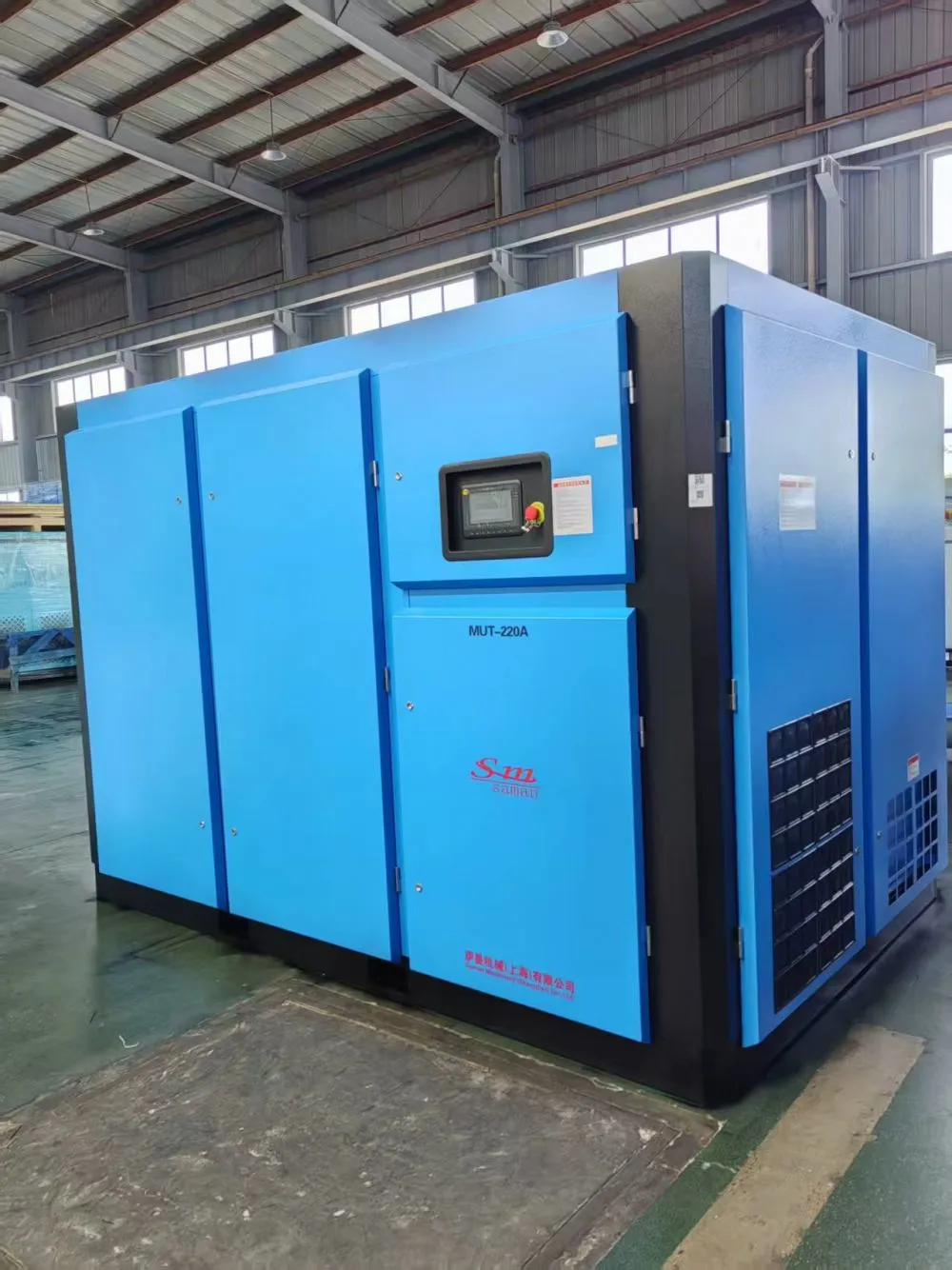
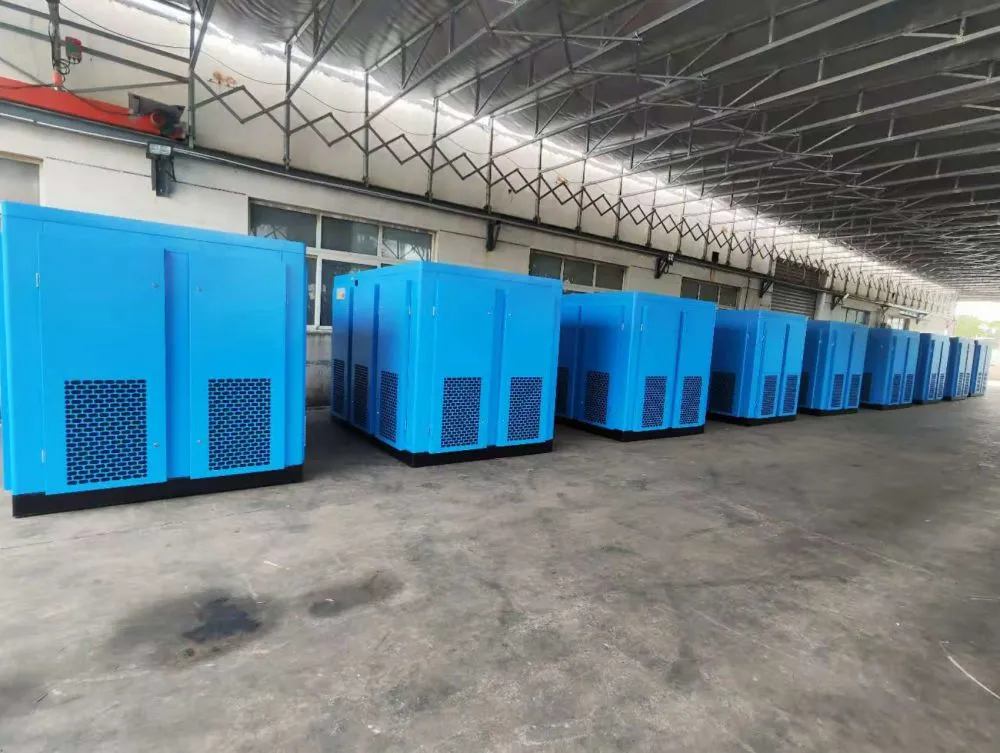
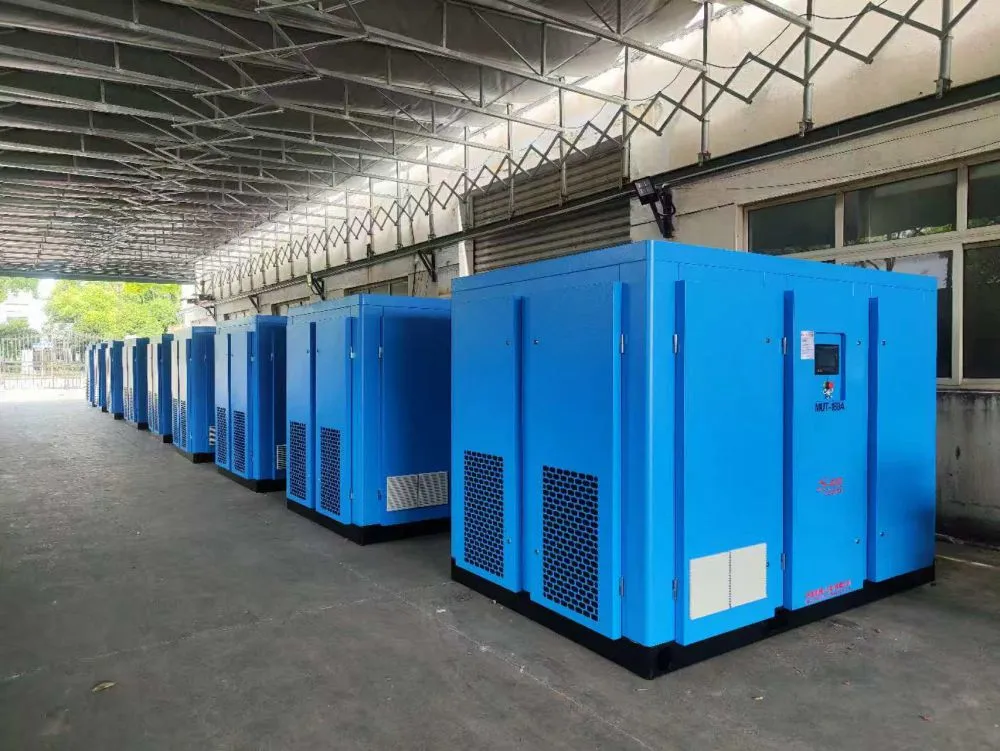
Two-stage compression permanent magnet variable-frequency screw air compressor
Detailed working principle
I. Overall working process
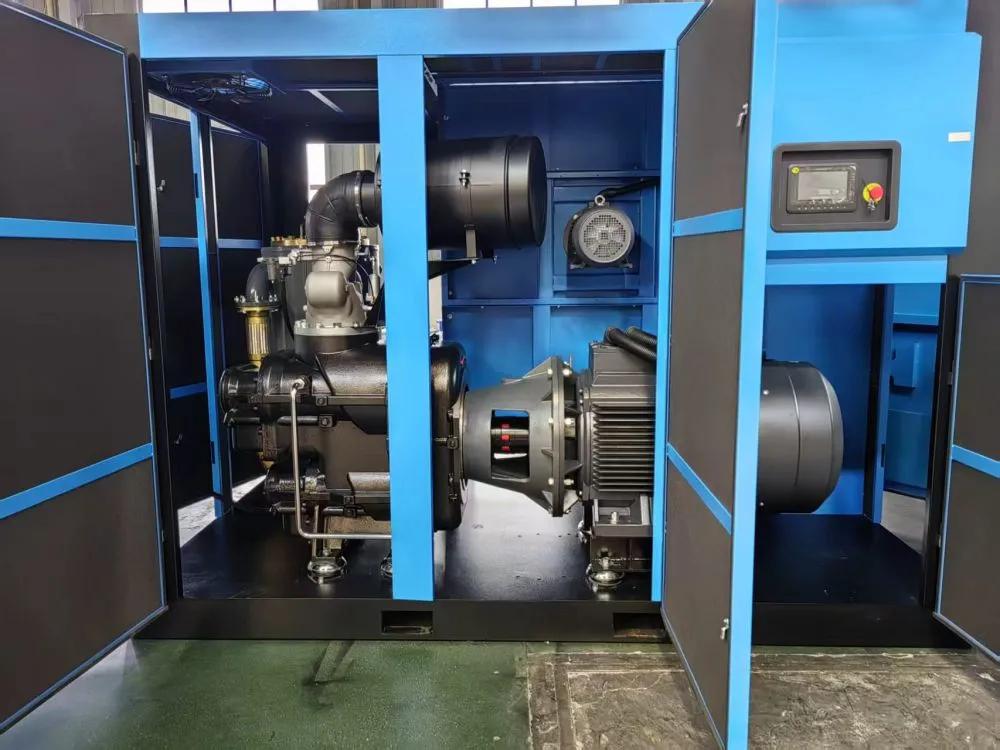
The entire machine adopts two-stage screw compression + inter-stage cooling + permanent magnet variable-frequency direct drive, achieving nearly isothermal compression, which is more efficient and energy-saving than traditional single-stage compression.
Complete process:
Air intake filtration → First-stage compression → Primary oil-gas separation → Inter-stage cooling → Second-stage compression → Secondary oil-gas separation → Post-cooling → Precision filtration → Constant pressure supply
II. Detailed principles of each section
1. Air intake and pre-treatment system
The outside air passes through an efficient air filter to remove dust and impurities.
The air intake regulating valve automatically adjusts the air intake volume according to the gas consumption.
Clean air enters the first-stage compression main unit.
2. First-stage compression (low-pressure stage)
Air enters the first-stage screw rotor (low-pressure rotor).
The magnetic rotor engages, and the volume gradually decreases, and the air is preliminarily compressed.
The outlet pressure of the first stage is generally: 3–5 bar
Compression process oil injection:
Lubricating the rotor and bearings
Sealing gap, reducing leakage
Absorbing compression heat, reducing exhaust temperature
The exhaust temperature of the first stage: approximately 100–120℃
3. Primary oil-gas separation and inter-stage cooling (energy-saving core)
The oil-gas mixture discharged from the first stage enters:
1) Primary oil-gas separator
Centrifugal + gravity separation to separate most of the oil droplets
The oil returns to the oil circuit for circulation
The air enters the inter-stage cooler
2) Inter-stage cooler
Forced cooling of the first-stage compressed air
The temperature drops from 100–120℃ to approximately 40–60℃ (close to normal temperature)
After cooling, the air density increases and the volume decreases, making the second-stage compression more energy-efficient
This is the key reason why the two-stage machine is more energy-efficient than the single-stage machine
4. Second-stage compression (high-pressure stage)
The cooled air enters the second-stage screw rotor:
The second-stage rotor is smaller and rotates at the same speed as the first stage
The cooled air is compressed from the intermediate pressure to the working pressure of 7–13 bar
The compression ratio of each stage is small, and the internal leakage is significantly reduced, resulting in higher volumetric efficiency
Again, oil injection for cooling, lubrication, and sealing
The exhaust temperature of the second stage is much lower than that of the single-stage machine
5. Secondary oil-gas separation system
The secondary exhaust enters the main oil-gas separator:
After centrifugal and fine separation filter, the separation efficiency is ≥99.99%
The exhaust contains less than 3 ppm of oil
Purely compressed air enters the post-cooler
6. Post-cooling and supply
The compressed air is cooled by the post-cooler
The condensate water is discharged by the automatic drain device
A precision filter can be selected as per requirements to further remove water, oil, and dust
Finally, it enters the network, providing constant pressure, stable, and clean air supply
III. Permanent magnet variable-frequency drive principle (enhancing the advantages of two-stage)
Using permanent magnet synchronous motor + frequency converter direct drive
Without gears or couplings, the transmission efficiency is close to 100%
The frequency converter automatically adjusts the speed according to the actual gas consumption:
High gas consumption → Increased speed → Increased gas supply
Low gas consumption → Decreased speed → Energy-saving operation
The pressure fluctuation is extremely small: ±0.1 bar
Avoid frequent loading and unloading, further saving energy
IV. Why is two-stage compression more energy-efficient? (Principle summary)
Two-stage pressure division
The total pressure is distributed to the two stages, with each stage having a small pressure ratio, less leakage, and higher efficiency.
Inter-stage cooling
After the first-stage compression, it is cooled to make the second-stage compression start from low-temperature air,
Approaching ideal isothermal compression, with the lowest power consumption.
Low exhaust temperature
The entire machine has a lower temperature, and the lubricating oil ages more slowly, resulting in a longer machine head lifespan.
Permanent magnet variable-frequency + two-stage stacking
Two-stage increases power ratio, frequency converter reduces no-load loss,
Overall energy-saving is more than 30% higher than the single-stage frequency conversion machine.
Recently Posted
-
PM VSD Single-stage vs Two-stage PM VSD Screw Air Compressors: How to Choose the Right Energy-saving
August 18, 2026IntroductionCompressed air serves as the power heart of all manufacturing plants, yet air compressors always rank among the bigges Read More
 -
Why PM VFD Screw Air Compressors Are the Best Investment for Modern Factories in 2026
August 10, 2026In modern industrial manufacturing, compressed air is regarded as the “fourth utility” after electricity, water, and gas. It power Read More
 -
Oil-free Silent Air Compressor, Clean Air Source for Industry
July 27, 2026Silent Oil-Free Air Compressor: Principle, Advantages and Industrial ApplicationIntroductionA silent oil-free air compressor is a Read More
 -
The working principle and technical application of high-pressure screw air compressors
June 25, 2026Comprehensive Analysis of High-Pressure Screw Air Compressors: Principles, Technology, Applications, and Selection & Maintenan Read More

Contact Us
Recommended Products
-
 Saman Permanent Magnet Variable-frequency Screw Air Compressor, Energy-saving, Low Power Consumption, Quiet and Environmentally FriendlyNegotiableMOQ: 1 Piece
 -
Saman Permanent Magnet Variable-frequency Screw Air CompressorNegotiableMOQ: 1 Piece
-
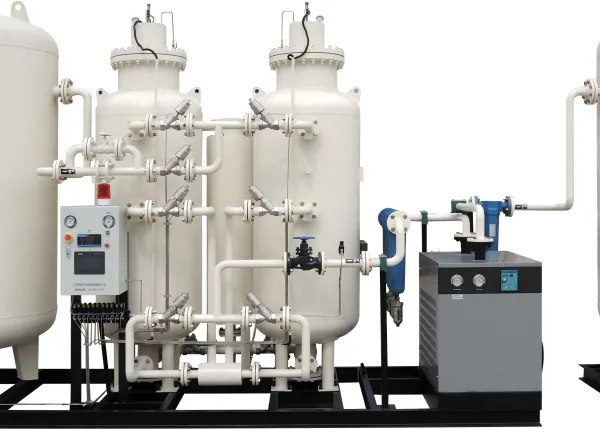
PSA Nitrogen Generator Industrial Nitrogen GeneratorNegotiableMOQ: 1 Piece
-
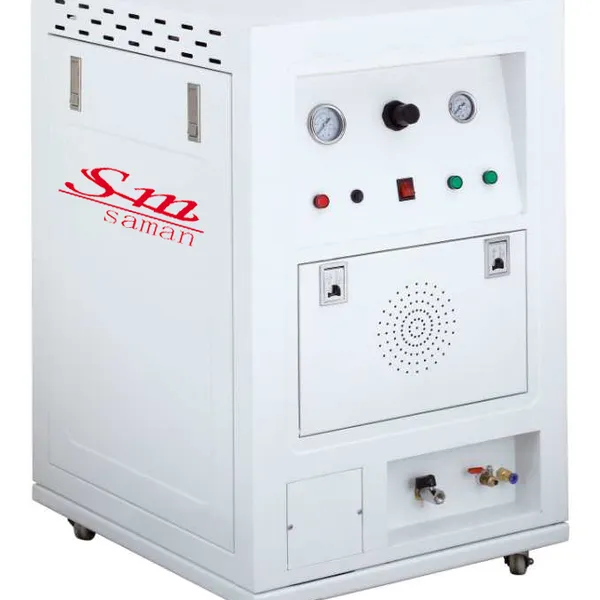
Silent Oil-free Air Compressor With Pure Gas Volume and 0 Oil ContentNegotiableMOQ: 1 Piece
-
Saman Portable Medical Oil-Free Silent Air CompressorM550—M1500*4NegotiableMOQ: 1 Piece
-
Saman High-Purity PSA Nitrogen Generator SMTYN01-SMTYN49NegotiableMOQ: 1 Piece
-
Saman Screw Air Compressor Manufacturer Directly Sells Products. There Are a Wide Variety of Models and Complete Series Available.NegotiableMOQ: 1 Piece
-
Saman Oil-free Vortex Air Compressor MW-11 - High-efficiency and Energy-saving Oil-free Air CompressorNegotiableMOQ: 1 Piece
-
Saman Oil-free Screw Air Compressor, Factory Direct Sales, Stable Quality, High Efficiency, and High Air OutputNegotiableMOQ: 1 Piece
-
Saman Permanent Magnet Variable-frequency Screw Air Compressor, Highly Efficient and Energy-savingNegotiableMOQ: 1 Piece
-
PSA Nitrogen Plant、Membrane Nitrogen Generator、Liquid Nitrogen Generator、Cryogenic Nitrogen PlantNegotiableMOQ: 1 Piece
-
Screw Air Compressor Three Filters, Air Filter Element, Oil Filter Element, Oil Separation ElementNegotiableMOQ: 1 Piece
-
Saman Permanent Magnet Variable Frequency Screw Air Compressor MV-150ANegotiableMOQ: 1 Piece
-
Saman PSA Nitrogen Generator One-stop Service Provider for High-quality Nitrogen SolutionsNegotiableMOQ: 1 Piece
-
Saman Screw-type Air Compressor, Permanent Magnet Variable-frequency Air Compressor, Double-stage Compression Screw Air CompressorNegotiableMOQ: 1 Piece
-
The Saman Mobile Screw Air Compressors Can be Divided Into Diesel Mobile Screw Air Compressors and Electric Mobile Screw Air Compressors.NegotiableMOQ: 1 Piece
-
Saman Pressure Swing Adsorption Nitrogen Generator, One-Stop Service for High-Quality Nitrogen SolutionsNegotiableMOQ: 1 Piece
-
Saman Screw Air Compressor Specializes in Providing Complete Air Compressors and Three-filter Consumables.NegotiableMOQ: 1 Piece
-
Saman Screw Vacuum Pump, With a Complete Range and a Wide Variety of Options, Offering High Selectivity.NegotiableMOQ: 1 Piece
-
Saman Permanent Magnet Variable Frequency Screw Air Compressor MV-150A, With a Power of 110KW and a Flow Rate of 20m³NegotiableMOQ: 1 Piece